While there are many types of car washes, most fall into the following categories:
Hand car wash facilities, where the vehicle is washed by employees.
Self-service facilities, which are generally coin-operated, where the customer does the washing, including "jet washing".
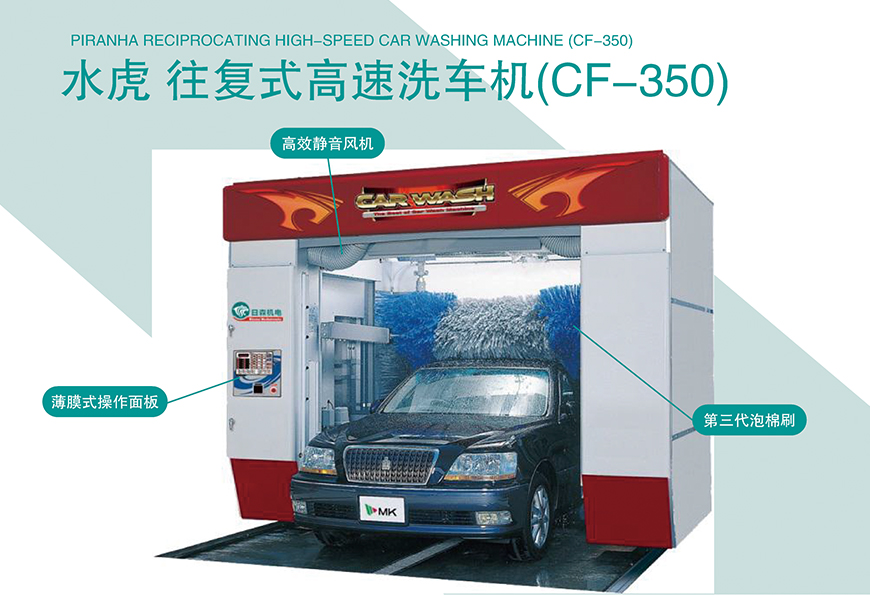
In-bay automatics, which consist of an automatic machine that rolls back and forth over a stationary vehicle - often seen at filling stations and stand-alone wash sites.
Tunnel washes, which use a conveyor to move the vehicle through a series of fixed cleaning mechanisms.
Chemical car wash, also known as waterless car wash, uses chemicals to wash and polish car surface. Thought to have originated in Australia and claims to be an eco-friendly car wash method.[citation needed]
Steam car washes use a jet of steam and micro fiber towels, some include detergent injection. Known to have originated from South Korea, steam car washes have been especially popular as a low-investment, eco-friendly car wash solution in Asia, Middle East and Europe thanks to its sanitizing features and mobility.[citation needed]
Mobile Car Washes, often also serving as mobile detailing systems, which carry plastic water tanks and use pressure washers. Sometimes these systems are mounted on trailers, on trucks, or in vans. Generally these operators also have a generator to run a shop vac., buffers and other tools as well.[citation needed]
Mechanized car washes, especially those with brushes, were once avoided by some meticulous car owners because of the risk of damaging the finish. Paint finishes have improved as have car washing processes, and this perception of vehicle damage is much less today. However, this perception was the motive behind the rise of facilities utilizing "brushless" (cloth) and "touch-free" (high-pressure water) equipment, as well as modern "foam" washing wheels made of closed cell foam.
In today's modern car wash facilities, whether tunnel, in-bay automatic or self-serve, soaps and other cleaning solutions used are designed to loosen and eliminate dirt and grime. This is in contrast to earlier times, when hydrofluoric acid, a hazardous chemical, was commonly used as a cleaning agent in the industry by some operators. There has been a strong move in the industry to shift to safer cleaning solutions. Most car wash facilities are required by law to treat and/or reuse their water and may be required to maintain waste-water discharge permits, in contrast to unregulated facilities or even driveway washing (at one's home), where waste-water can end up in the storm drain and, eventually, in streams, rivers and lakes.
Self-serve car wash[edit]
A multi-bay self-service car wash, with an automatic "touchless" bay at the far left and manual bays on the right.
A simple and automated type of car wash that is typically coin-operated or token-operated self-service system. Newer self-service car washes offer the ability to pay with credit cards or loyalty cards. The vehicle is parked inside a large covered bay that is equipped with a trigger gun and wand (a high-pressure sprayer) and a scrub foam-brush. When customers insert coins or tokens into the controller, they can choose options such as soap, tire cleaner, wax or clear water rinse, all dispensed from the sprayer, or scrub the vehicle with the foam-brush. The number of coins or tokens inserted determines the amount of time customers have to operate the equipment; in most instances, a minimum number of coins are necessary to start the equipment. These facilities are often equipped with separate vacuum stations that allow customers to clean the upholstery and rugs inside their cars. Some self-service car washes offer hand-held dryers, a somewhat new feature.
Automatic car wash[edit]
Rotating brushes inside a conveyor car-wash.
The first conveyorized automatic car washes appeared in the late 1930s. Conveyorized automatic car washes consist of tunnel-like buildings into which customers (or attendants) drive. Some car washes have their customers pay through a computerized POS, or point of sale unit, also known as an "automatic cashier", which may take the place of a human cashier. The mechanism inputs the wash PLU into a master computer or a tunnel controller automatically. When the sale is automated, after paying the car is put into a line-up called the stack or queue. The stack moves sequentially, so the wash knows what each car purchased. After pulling up to the tunnel entrance, an attendant usually guides the customer onto the conveyor. At some washes, the system will send the correct number of rollers automatically, based on tire sensors. The tire sensor lets the wash know where the wheels are and how far apart they are. On other systems the employee may guide the customer on and press a 'Send Car' button on the tunnel controller, to manually send the rollers which push the car through.
When the customer is on the conveyor, the attendant (or signage) will instruct the customer to put the vehicle into neutral, release all brakes, and refrain from steering. Failure to do so can cause an accident on the conveyor. The rollers come up behind the tires, pushing the car through a detector, which measures vehicle length, allowing the controller to tailor the wash to each individual vehicle. The equipment frame, or arches, vary in number and type. A good car wash makes use of many different pieces of equipment and stages of chemical application to thoroughly clean the vehicle.
A vehicle in the high pressure rinse stage of the wash. Also visible is the conveyor.
The carwash will typically start cleaning with pre-soaks applied through special arches. They may apply a lower pH (mild acid) followed by a higher pH (mild alkali), or the order may be reversed depending on chemical suppliers and formula used. Chemical formulas and concentrations will also vary based upon seasonal dirt and film on vehicles, as well as exterior temperature, and other factors. Chemical dilution and application works in combination with removal systems based on either high pressure water, friction, or a combination of both. Chemical substances, while they are industrial strength, are not used in harmful concentrations since car washes are designed not to harm a vehicle's components or finish.
The customer next encounters tire and wheel nozzles, which the industry calls CTAs (Chemical Tire Applicators). These will apply specialized formulations, which remove brake dust and build up from the surface of the wheels and tires. The next arch will often be wraparounds, usually made of a soft cloth, or closed cell foam material. These wraparounds should rub the front bumper and, after washing the sides, will follow across the rear of the vehicle cleaning the rear including the license plate area. Past the first wraps or entrance wraps may be a tire brush that will scrub the tires and wheels. This low piece is often located beneath a mitter (the hanging ribbon-like curtains of cloth that move front to back or side to side) or top wheels. There may also be rocker panel washers which are shorter in size (ranging in size from 18 inches [45 cm] up to 63 inches [160 cm] tall) that clean the lower parts of the vehicle. Most rocker brushes house the motor below the brush hub so they don't inhibit cloth movement and allow the brush to be mounted under a support frame or below a mitter. Some car washes have multiple mitters, or a combination of mitters and top brushes.
Typical "tunnel" car wash view from the inside
After the mitter or top brush(es) the car may pass through a second set of wraparounds. This may also be where high pressure water streams are used to clean difficult to reach parts of the vehicle. The car generally passes over an under carriage wash and/or has high pressure nozzles pointed at it from various positions. Next may be a tire spinner, high pressure nozzles angled specifically to clean wheels and tires. After the several wash stations the vehicle may go through triple foamers, usually red, blue, and yellow, although colors can be customized with higher end chemical suppliers. The triple foam process includes special cleaners as well as some protective paint sealant.
Some washes have multiple rinse stages, usually offering a protectant as an option.
Protectants vary by manufacturer. Near the rinse is where a tire shining machine is often installed, which is designed to apply silicone tire dressing to the tires. This application makes the tires look good (new, and glossy) and preserves the rubber. Next the vehicle is treated with a drying agent and a final rinse. Many carwashes utilize a "spot free" rinse of soft water, that has been filtered of the salts normally present, and sent through semi-permeable membranes to produce highly purified water that will not leave spots. After using spot free water, the vehicle is finished with forced air drying, in some cases utilizing heat to produce a very dry car.
A touchless car wash
Older automatic washes - a majority of which were built prior to 1980 - used to use brushes with soft nylon bristles, which tended to leave a nylon deposit in the shape of a bristle, called brushmarks, on the vehicle's paint. Many newer washes in the US are either cloth (which is not harmful to a car's finish, as long as it is flushed with plenty of water to remove the grit from previous washes) or a closed cell foam brush, which does not hold dirt or water, thus is far less likely to harm any painted finish. Closed cell foam brushes can, in fact, provide a gentle polishing effect that will shine the vehicle's surface during a wash.
In order to avoid marking paintwork, "touchless" (aka "touchfree" or "no-touch") car washes were developed. A touchless car wash uses high water pressure to clean the vehicle instead of brushes, minimizing the chance of surface damage to the vehicle. There are five primary factors to cleaning a vehicle successfully using a touchless system. These five factors are water quality, water temperature, chemistry, time, and water pressure generated by the equipment. If these factors are all set properly, vehicles will come out clean and shiny without the chance of vehicle damage caused by brushes.
At "full-service" car washes, the exterior of the car is washed mechanically with conveyorized equipment, or in some cases by hand, with attendants available to dry the car manually, and to clean the interior (normally consisting of cleaning the windows, wiping the front and side dashes, and vacuuming the carpet and upholstery). Many full service car washes also provide "detailing" services, which may include polishing and waxing the car's exterior by hand or machine, shampooing and steaming interiors, and other services to provide thorough cleaning and protection to the car.
Bikini car wash[edit]
Bikini car washes are typically a summer events which are fund raisers for a school, a sport association or other youth organizations or charities. Typically, women in bikinis bring in donors by standing on a roadside with colorful cardboard signs or posters, and the cars are washed by their classmates in a nearby parking lot. Depending on the organization responsible, as well as the local laws, a variation of the bikini car wash sometimes occurs, in which the women will wash the car topless, usually for an extra fee. There are also commercial bikini car washes, where bikini-clad women actually wash the cars for a fee and the entertainment of the drivers. Hooters restaurants usually have bikini car washes in the summer to attract customers.
Environmental factors[edit]
The primary environmental considerations for car washing are:
Use of water and energy resources;
Contamination of surface waters;
Contamination of soil and groundwater.
Use of water supplies and energy are self-evident, since car washes are users of such resources. The professional car wash industry has made great strides in reducing its environmental footprint, a trend that will continue to accelerate due to regulation and consumer demand. Many car washes already use water reclamation systems to significantly reduce water usage and a variety of energy usage reduction technologies. These systems may be mandatory where water restrictions are in place.
Contamination of surface waters may arise from the rinse discharging to storm drains, which eventually drain to rivers and lakes. Chief pollutants in such wash-water include phosphates; oil and grease; and lead. This is almost exclusively an issue for home/driveway washing, and parking lot style charity washes. Professional carwashing is a "non-point source" of discharge that has the ability to capture these contaminants, normally in interceptor drains, so the contaminants can be removed before the water enters sanitary systems. (Water and contaminants that enter storm water drains does not undergo treatment, and is released directly into rivers, lakes and streams.)
Soil contamination is sometimes related to such surface runoff, but more importantly is associated with soil contamination from underground fuel tanks or auto servicing operations which commonly are ancillary uses of car wash sites — but not an issue for car washing itself.
For these reasons, some state and local environmental groups (the most notable being the New Jersey Department of Environmental Protection) have begun campaigns to encourage consumers to use professional car washes as opposed to driveway washing, including moving charity car wash fund raisers from parking lots to professional car washes.